Article: Why Does My New Leather Bag Look Used? Natural Marks in Full-Grain Leather Explained
Why Does My New Leather Bag Look Used? Natural Marks in Full-Grain Leather Explained
 You unwrap your new leather bag and notice a fine line across the surface, a wrinkle near the opening, or a panel with a slightly different tone. It is natural to wonder whether the bag has already been used—but with full-grain leather, these details are often part of the hide itself.
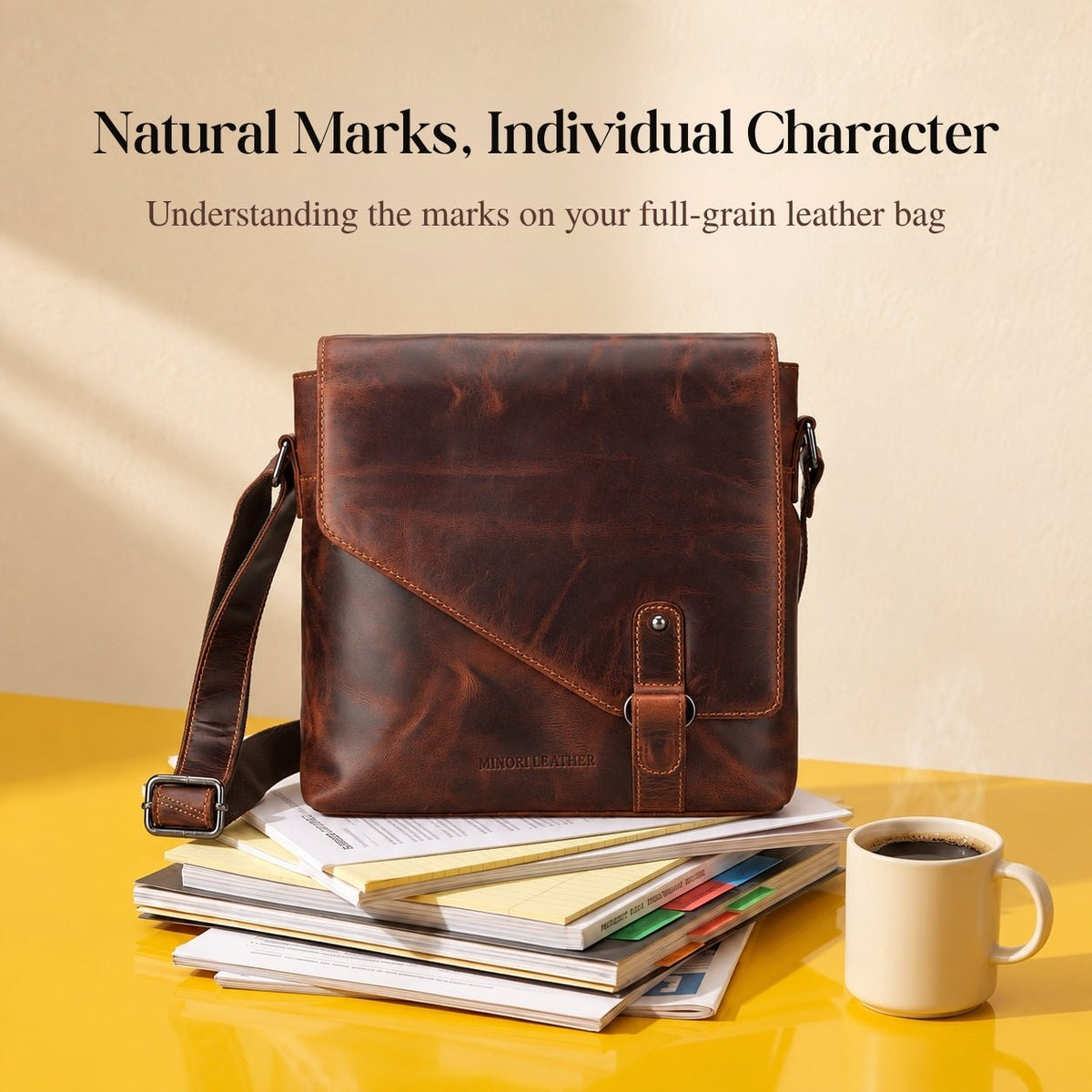
Unlike heavily corrected leather or synthetic materials, full-grain leather retains its natural grain. Fine wrinkles, healed scars, grain variations and subtle differences in color help make every bag unique. Oil pull-up leather may also develop lighter surface marks when it is folded, shaped or handled during production and packing.
These characteristics do not, by themselves, mean that your bag has been used. In this guide, we explain which markings are natural, why oil pull-up leather changes when touched or bent, and when you should contact us for assistance.
1. Why Can a Brand-New Leather Bag Have Marks?
Full-grain leather begins as an animal hide with a surface shaped by natural growth and movement. Fine wrinkles, small healed scars and variations in grain may remain visible after the leather has been tanned and finished.
Each bag also goes through cutting, stitching, shaping and careful handling before it reaches you. On oil pull-up leather, bending a panel or folding a strap may temporarily shift the oils and waxes within the leather, creating lighter areas or lines.
As a result, a brand-new full-grain leather bag may not have the completely uniform appearance associated with synthetic or heavily corrected materials. These natural details are part of the leather’s character—not necessarily signs of previous use.
2. Full-Grain Leather Is Not Meant to Look Perfectly Uniform
Full-grain leather retains the hide’s original grain surface instead of being heavily sanded or buffed to remove its natural characteristics.
Heavily corrected leather and synthetic materials can be manufactured with a more consistent, repeating surface pattern. Naturally finished full-grain leather, however, may show differences between separate hides and even between different sections of the same hide.
For example, the front panel of a bag may have a finer grain, while a side panel has a more pronounced texture. Two bags in the same style and color may also have subtle differences in grain or tone.
These variations give full-grain leather its depth and individuality. Rather than appearing identical and factory-perfect, each bag carries a grain pattern belonging to that particular hide. The visibility of these natural characteristics will vary depending on the leather and its finish.
3. Natural Marks You May Notice on a New Leather Bag

Natural leather characteristics can appear in several ways. The following are generally normal when they are minor and do not affect the leather’s strength or the bag’s construction.
Natural grain variations
One area of the bag may look smooth and fine-grained, while another has a more pronounced texture. Because the leather retains its original grain, the pattern does not need to repeat evenly across every panel.
Small healed scars
Small, closed scars may remain from the animal’s life. They form part of the hide’s natural history and are different from an open cut, tear or split in the finished leather.
Fine wrinkles and growth lines
Fine wrinkles may reflect the hide’s natural growth and movement. These lines can remain visible after tanning without affecting the durability or performance of the leather.
Light creases
Gentle creases may appear where the leather has been bent during construction, shaping or packing. They may also occur naturally around flexible parts of the bag, such as the opening, flap or strap.
Variations in texture
Different sections of the hide may feel slightly smoother or more textured. This can be particularly noticeable when separate sections of leather are used to construct different panels of the bag.
Light surface marks
Oil pull-up leather may develop pale lines or lighter areas through ordinary contact, bending and handling. These markings generally affect the oil-and-wax finish rather than cutting into the leather itself.
Subtle color and tonal variations
Natural differences in the hide, dye absorption and the oil-and-wax finish may create gentle variations in shade. These tonal changes add visual depth and help make every full-grain leather bag individual.
4. Why Oil Pull-Up Leather Changes Color When Touched or Bent
Oil pull-up leather is infused with oils and waxes during the finishing process. When the leather is pressed, bent or stretched, these oils and waxes shift within the material, making the affected area appear temporarily lighter. This is known as the pull-up effect.
It explains why a folded strap, curved edge or flexible section of a new bag may look lighter than a flat panel. The effect varies depending on the leather, color and finish, and some pull-up markings may be more noticeable than others.
This responsiveness is one of the distinctive visual characteristics of oil pull-up leather. It also contributes to the rich, evolving appearance the leather develops with use.
For a fuller explanation, read What Is Oil Pull-Up Leather? The Ultimate Guide.
5. Natural Character vs. Marks That Need Review
When examining a mark on your leather bag, consider its depth and the overall condition of the item. The following comparison can help you identify what may be natural and what should be photographed and reported to our team.
| May be a natural leather characteristic | Please contact Minori for review |
|---|---|
| Grain that varies between panels | Deep cuts, tears or exposed fibers |
| Small healed scars and fine wrinkles | Open splits or cracked areas |
| Light creases at flexible points | Severe distortion or damage along a fold |
| Subtle tonal differences | Stains, spill marks or sticky residue |
| Superficial, lighter pull-up lines | Deep scratches that break the surface |
| Slight variation in surface texture | Peeling or flaking material |
Concerns such as a visibly soiled lining, strong unusual odor, broken hardware, or torn and unraveling stitching are unrelated to the leather’s natural grain and should be reported to our team.
If you are unsure, you do not need to decide for yourself whether a mark is natural. Send us clear photographs, and we will be happy to review it for you.
For more about surface marks and deeper scratches, see Does Full-Grain Leather Scratch? Here’s Why That Can Be a Good Thing.
6. Can Light Marks on Oil Pull-Up Leather Be Reduced?
Some superficial marks on oil pull-up leather may soften when gently rubbed with clean, dry fingers or a clean, soft cloth. Light pressure and the natural warmth of your hand can help redistribute the oils already present within the leather.
Always use a gentle touch and avoid forceful or repeated rubbing. Not every mark will disappear, and a mark that remains visible is not automatically a sign of damage. Natural grain patterns and healed scars, for example, will not rub away.
This method is suitable only for superficial marks in the finish. It will not repair a deep scratch, cut, tear or damaged stitching.
If a mark concerns you, photograph it and contact us before applying leather conditioners, cleaners or other treatments.
If a mark looks concerning, photograph it and contact us before applying products or attempting repairs. For routine maintenance, read How to Care for Your Oil Pull-Up Minori Leather Bag.
7. How Your Leather Bag Will Change with Use
Naturally finished full-grain leather continues to evolve over time. Regular handling and everyday use may gradually change its color, softness and sheen, creating what is known as a patina.
The areas you touch most often may become smoother or slightly darker, while folds and edges may develop additional tonal depth. These gradual changes make the appearance of each bag increasingly personal to its owner.
Patina develops naturally with time and use. It is different from damage that is already present when a bag arrives.
Patina develops gradually; it should not be used to explain away damage on arrival. Read Full-Grain Leather Patina: How It Forms for more detail.
8. When Should You Contact Minori Leather?
Please contact us if your new bag has a deep cut, open split, obvious stain, broken hardware, damaged stitching, or anything else that appears to go beyond the natural characteristics of the leather.
You are also welcome to contact us whenever you are unsure. You do not need to diagnose the issue yourself before asking for assistance.
Email sales@minorileather.com with:
- Your order number
- A short description of your concern
- A photograph showing the complete bag
- Clear close-up photographs of the affected area
- Photographs of the lining or hardware, if relevant
When possible, take the photographs in natural daylight without filters so that we can see the leather’s color and texture accurately.
Our team will review the concern and advise you on the appropriate next steps. You can also reach us through our contact page.
9. Final Thoughts: Natural Variation Makes Every Bag Unique
Full-grain leather is valued because it retains the hide’s natural grain rather than hiding it beneath a perfectly uniform surface. Fine wrinkles, subtle tonal variations, healed scars and light pull-up marks give each Minori Leather bag its own character from the beginning.
These details do not, by themselves, mean that a bag has been used. They are often part of what makes genuine full-grain leather distinctive—and as the leather develops a patina, your bag will become even more individual.
If you ever notice something that appears to go beyond natural variation, our team will be happy to review it with you.
Frequently Asked Questions
Does a mark on a new leather bag mean it has been used?
No. A mark may be a natural characteristic of the hide or a superficial change in the oil-and-wax finish caused by shaping, handling or packing. Look at the overall condition of the bag, and contact Minori Leather if anything concerns you.
Does full-grain leather naturally have wrinkles?
Yes, full-grain leather can have fine wrinkles and growth lines that reflect the hide’s natural surface. Gentle creases may also form where the leather bends. Deep cracking, open splitting or significant distortion should be photographed and reported for review.
Are scars normal in full-grain leather?
Small, closed and healed scars may remain visible because full-grain leather retains the hide’s natural grain. An open cut, split, tear or area with exposed fibers is different and should be reported to our team.
Should every mark on oil pull-up leather rub away?
No. Some light surface marks may soften when the oils redistribute, while others may remain visible. Natural grain patterns, growth lines and healed scars will not rub away. Avoid repeated or forceful rubbing in an attempt to make the surface completely uniform.
Why are some panels of my bag slightly different in color or texture?
Separate panels may come from different sections of the hide. Natural differences in grain, dye absorption, oils and waxes can produce subtle changes in texture or tone. These variations help make every full-grain leather bag unique.
What should I do if I cannot tell whether a mark is natural or damaged?
Send our team your order number and clear photographs before applying any treatment. Include an image of the complete bag and close-ups of the area in natural daylight. We will review the leather and help you understand the appropriate next steps.



Leave a comment
This site is protected by hCaptcha and the hCaptcha Privacy Policy and Terms of Service apply.