
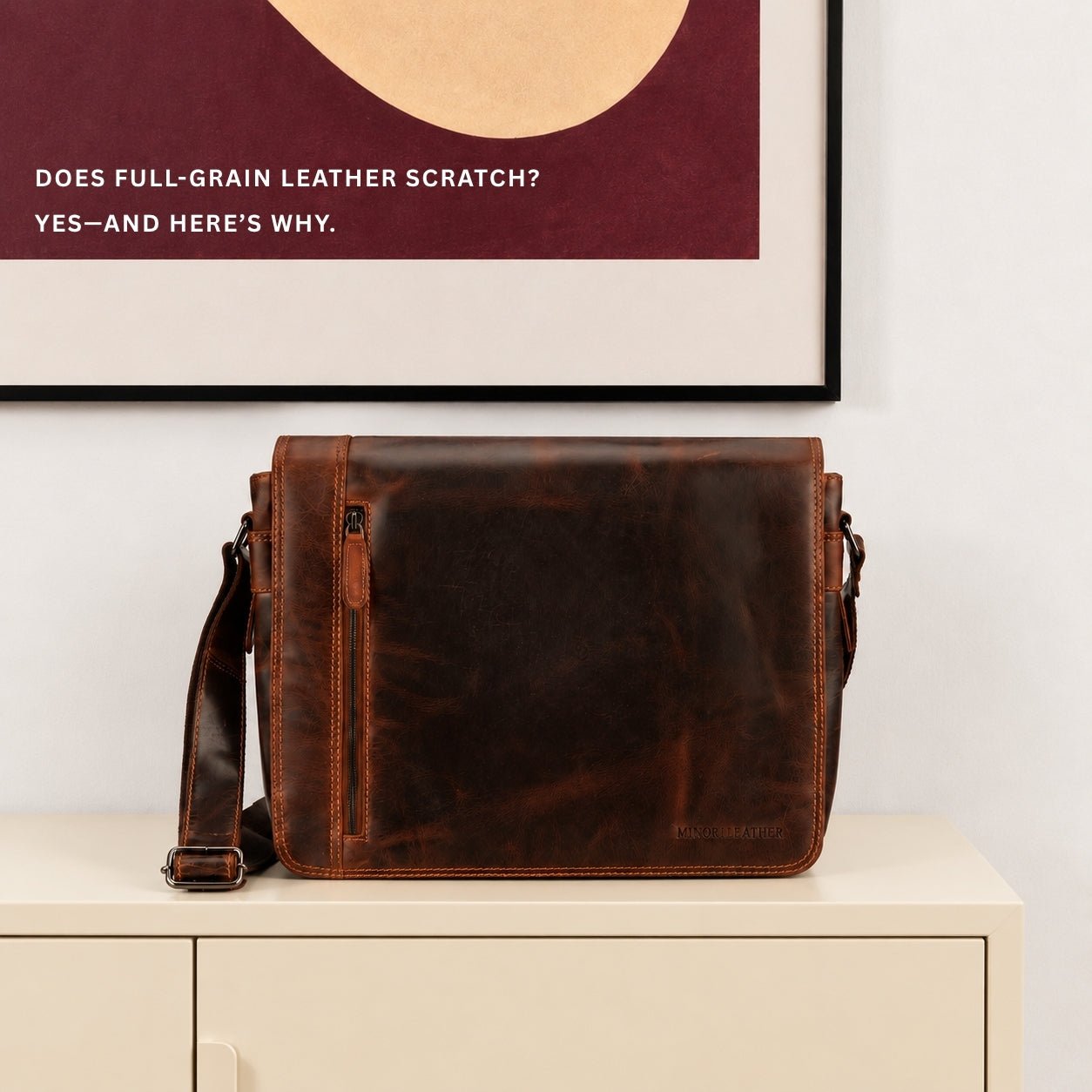
Does Full-Grain Leather Scratch? Here’s Why That Can Be a Good Thing
Yes, full-grain leather can scratch. In fact, some full-grain leathers, particularly lightly finished and oil pull-up leathers, show surface marks more readily than heavily coated leather.
That does not necessarily mean the leather is weak, poor quality or permanently damaged.
Because full-grain leather retains its natural surface rather than being mechanically corrected to create a uniform appearance, it responds visibly to touch, friction, pressure and everyday use. Many light scratches can soften, blend or gradually become part of the leather’s developing patina.
The key is understanding the difference between a light surface mark, a deeper scratch and actual leather damage.
What Is Full-Grain Leather?
Full-grain leather is leather that retains its complete natural grain. Its surface has not been mechanically buffed or sanded to remove the grain and conceal natural characteristics.
The Leather Working Group defines full grain as leather that has kept its entire grain without the surface being removed through corrective mechanical treatment. By comparison, corrected-grain leather has had part of its natural grain removed by buffing or a similar process before being refinished.
Because the original surface remains, full-grain leather can display natural characteristics such as:
- Variations in grain
- Creases and wrinkles
- Subtle changes in color
- Small natural markings
- Differences between one section of a hide and another
These characteristics are not automatically flaws. They are part of what distinguishes natural leather from highly corrected or synthetic materials.
You can learn more about the materials and finishes used in our bags on Minori Leather’s Our Leather page.
Why Does Full-Grain Leather Scratch?
Any type of leather can be marked by friction, pressure or contact with a sharp object. How visible the scratch becomes depends on the leather’s finish, color, oil content and intended appearance.
Heavily pigmented leather has a more substantial surface coating. This coating can conceal some minor marks and create a more uniform appearance.
Natural-looking full-grain leather is often finished more lightly so that its grain remains visible. As a result, surface contact may show more clearly—even though the leather’s underlying fiber structure remains strong.
This is especially noticeable with oil pull-up leather.
Why Oil Pull-Up Leather Shows Marks?
Oil pull-up leather is infused with oils and waxes that move within the leather when it is bent, stretched, pressed or handled. The Leather Working Group defines pull-up leather as leather designed to lighten in color when stretched.
When the surface is rubbed or lightly scratched, these oils can temporarily shift away from the affected area. This creates a lighter line that may appear more dramatic than the actual depth of the scratch.
Gently rubbing the area may help redistribute the oils and reduce the appearance of the mark. Over time, many light scratches blend into the surrounding color and character of the leather.
Are Scratches on Full-Grain Leather a Bad Sign?
Not always. A visible mark will generally fall into one of three categories.
 1. A Light Surface Mark
A light mark affects the oils, waxes or finish close to the surface rather than cutting into the leather.
It may:
- Feel smooth when you run a finger across it
- Become less visible when gently rubbed
- Respond to the warmth of your hand
- Blend into the leather through regular use
These are the marks most likely to soften and become part of the leather’s patina.
2. A Deeper Scratch
A deeper scratch penetrates further into the leather and may feel indented, raised or rough. It might improve with careful conditioning, but it may not disappear completely.
Treat this type of mark conservatively. Aggressive rubbing or applying too much product can darken the area without removing the scratch.
3. A Cut, Tear or Finish Damage
If the leather is split, torn, peeling, exposing fibers or losing color across a large area, the problem is more than an ordinary surface scratch.
Deep cuts, damaged stitching and significant finish damage should generally be assessed by a professional leather repair specialist.
Why Scratches Can Be a Good Thing
No one wants to deliberately damage a leather bag. However, the way quality natural leather responds to everyday use is part of its appeal.
They Reflect a More Natural Surface
Full-grain leather preserves the hide’s natural grain instead of mechanically removing it to create a perfectly uniform surface.
This does not mean that every scratch proves a product is made from full-grain leather. It means that variations and visible responses to use can be expected from many naturally finished full-grain leathers.
A more natural finish allows the leather’s texture and changing character to remain visible instead of hiding every mark beneath a heavy coating.
Many Light Marks Can Be Blended
A light scratch in oil pull-up leather is often caused by the movement of oils and waxes rather than permanent structural damage.
Gently rubbing the mark with clean fingers or a soft cloth can sometimes redistribute those oils. If the leather is dry, a small amount of a suitable leather conditioner may also help—provided it is tested first and used sparingly.
Scratches Can Contribute to Leather Patina
Leather patina is the gradual change in a leather item’s color, texture, sheen and surface character through handling, exposure and regular use.
Patina may include:
- Slight darkening in frequently handled areas
- A softer feel
- Increased sheen at contact points
- Subtle tonal variations
- Blended scuffs and surface marks
- Creasing where the leather naturally bends
 Patina is not a single scratch. It is the combined effect of time and use across the leather’s surface.
Industry sources describe high-quality full-grain leather as developing individual character and patina over time. Leather UK describes naturally finished full-grain leather as gaining a patina unique to each item.
A well-used leather bag may therefore look different after several years without looking worn out. Its appearance becomes more personal to the way it has been carried, handled and cared for.
Patina vs. Damage: What Is the Difference?
Patina develops gradually and is consistent with the natural aging of leather. Damage compromises the material, its finish or the product’s ability to function properly.
|
Patina and normal wear
|
Possible leather damage
|
|---|---|
|
Soft changes in color
|
Peeling or flaking surface
|
|
Light surface scratches
|
Deep cuts or exposed fibers
|
|
Natural creasing
|
Torn leather
|
|
Slight darkening from handling
|
Significant water damage
|
|
Gradual softening
|
Broken or separated seams
|
|
Blended scuffs
|
Mold or persistent odor
|
Full-grain leather can still be damaged. Calling every mark “patina” would be misleading. The depth of the mark and the condition of the surrounding leather both matter.
How to Remove Light Scratches From Full-Grain Leather?
Before treating scratched leather, determine whether the mark is on the surface or penetrates deeper into the material. For a light surface scratch, begin with the least invasive method.
 Step 1: Remove Surface Dust
Use a clean, dry and soft cloth to remove dust or grit from the affected area. Rubbing dirt against the leather can create additional marks.
If necessary, use a slightly damp cloth. Do not soak the leather, and allow it to dry naturally before continuing.
Step 2: Gently Rub the Scratch
Using a clean fingertip or soft cloth, gently rub the mark in small circles.
On oil pull-up leather, warmth and light pressure may help redistribute the oils and make the scratch less noticeable. Do not scrub aggressively.
Step 3: Lightly Buff the Area
Buff the surface gently with a clean microfiber or other soft, lint-free cloth. Work slightly beyond the exact scratch so the finish remains visually even.
The goal is to blend a light mark—not grind it away.
Step 4: Apply a Compatible Leather Conditioner if Needed
If the leather appears dry, apply a very small amount of conditioner designed for the particular type of leather.
Always:
- Read the care-product instructions
- Test it on a concealed area first
- Check for darkening or changes in sheen
- Use a small amount
- Apply the product evenly
- Allow the leather to dry naturally
Conditioner may reduce the appearance of certain surface scratches, but it cannot close a deep cut.
General guidance recommends cleaning, conditioning and protecting leather while storing it away from intense heat and direct sunlight.
Step 5: Know When to Stop
If the mark remains visible after gentle care, repeatedly applying more conditioner is unlikely to solve the problem. Excess product may darken the leather, leave residue or create an uneven finish.
A small remaining mark may gradually soften through normal use. A deep scratch should be evaluated by a professional.
What Not to Use on Scratched Leather?
Many online remedies are not suitable for every leather type or finish. Avoid applying household substances without confirming that they are safe for the specific leather.
Do not automatically use:
- Olive oil or cooking oil
- Untested shoe polish
- Alcohol or hand sanitizer
- Household cleaning sprays
- Baby wipes
- Petroleum jelly
- Heat from a hair dryer
- Abrasive brushes or sponges
- Large amounts of water
These treatments may darken the leather, remove color, weaken the finish or create a permanent patch.
When in doubt, use a care product made for the particular type of leather or consult the product’s manufacturer.
Can All Scratches Be Removed From Leather?
No. Light surface scratches can often be reduced, blended or incorporated into the leather’s patina. Deep scratches may remain visible even after careful conditioning.
The result depends on:
- The depth of the scratch
- The leather’s surface finish
- Whether the leather is dry
- The color of the leather
- Whether the fibers have been cut
- Products previously applied to the surface
The realistic goal is not always to restore leather to a factory-new appearance. With natural full-grain leather, careful treatment should preserve the material rather than disguise every sign of use.
How to Protect a Full-Grain Leather Bag?
Full-grain leather is durable, but thoughtful care can help it age more evenly.
Keep Sharp Objects Separate
Keys, metal edges and uncovered pens can create deeper scratches inside a bag. Use interior pockets or a small pouch when possible.
Avoid Overfilling
Regularly overstuffing a bag can place unnecessary stress on its shape, seams, closures, straps and handles.
Keep It Away From Excessive Moisture
A few drops of water do not automatically ruin leather, but soaking can lead to staining, stiffness or uneven drying.
If your bag becomes wet, blot away excess moisture with a clean cloth and allow it to dry naturally. Avoid hair dryers, heaters and direct sunlight.
Store It Properly
When the bag is not being used:
- Empty its pockets
- Lightly support its shape
- Store it in a breathable dust bag
- Keep it away from direct sunlight
- Avoid damp or poorly ventilated spaces
- Do not seal it in plastic for extended periods
Clean and Condition It Carefully
Remove surface dust with a soft cloth and condition the leather only when needed. The appropriate schedule depends on the type of leather, climate and frequency of use rather than a rigid timetable.
Applying too much conditioner can be just as unhelpful as applying too little.
Should You Avoid Full-Grain Leather Because It Scratches?
Not if you appreciate natural materials that change with use.
Full-grain leather may not be the right choice for someone who wants a bag to remain completely uniform and untouched-looking. A heavily coated material may initially conceal minor marks more effectively.
However, if you value natural grain, durability and a surface that gains individual character over time, occasional light scratches do not have to be treated as defects.
They are evidence that the bag is being used—and with suitable care, many of those marks will soften into a patina that is entirely your own.
Explore more leather-care advice, buying guides and material education in the Minori Leather Journal.
Frequently Asked Questions
Does Full-Grain Leather Scratch Easily?
Full-grain leather can show scratches, particularly when it has a light finish or an oil pull-up effect. How visible a mark becomes depends on the finish, color and oil content. Showing a surface scratch does not necessarily mean the leather is weak.
Can You Fix Scratched Leather?
Many light scratches can be reduced by gently rubbing or buffing the area. A small amount of compatible leather conditioner may help if the leather is dry. Deep scratches, cuts and significant finish damage may require professional repair.
How Do You Get Scratches Out of Leather?
Start by removing dust with a soft cloth. Gently rub and buff the mark. If appropriate for the particular leather, apply a small amount of tested conditioner. Avoid aggressive rubbing, household oils and excessive heat.
Can You Buff Scratches Out of Leather?
Some light surface scratches can become less visible after gentle buffing with a clean, soft cloth. Deeper scratches cannot be safely buffed away and may require professional attention.
Do Scratches Become Part of Leather Patina?
Light scuffs and surface marks can blend into the broader patina that develops through handling and regular use. A deep cut is damage, however, and should not be described as patina.
What Is Leather Patina?
Leather patina is the gradual evolution of the material’s color, texture, sheen and surface character. It develops through handling, movement, exposure and everyday use.
Does All Leather Develop a Patina?
Leather ages, but not every leather develops patina in the same way. The tanning method, surface finish, coatings, color and frequency of use all influence the result. Heavily pigmented leather may show less visible variation than naturally finished leather.
Can I Use Olive Oil to Remove a Leather Scratch?
Using olive oil is not recommended. Cooking oils can darken leather, become rancid or create an uneven patch. Use a care product intended for the particular type of leather and test it in a hidden area first.
Is Scratched Full-Grain Leather Defective?
Not necessarily. Minor surface marks and natural variations can be normal characteristics of full-grain leather. Deep cuts, peeling, tearing or extensive finish failure may indicate damage and should be evaluated separately.



Leave a comment
This site is protected by hCaptcha and the hCaptcha Privacy Policy and Terms of Service apply.