
Article: Leather Bag Size Guide: How to Choose the Right Bag Online.
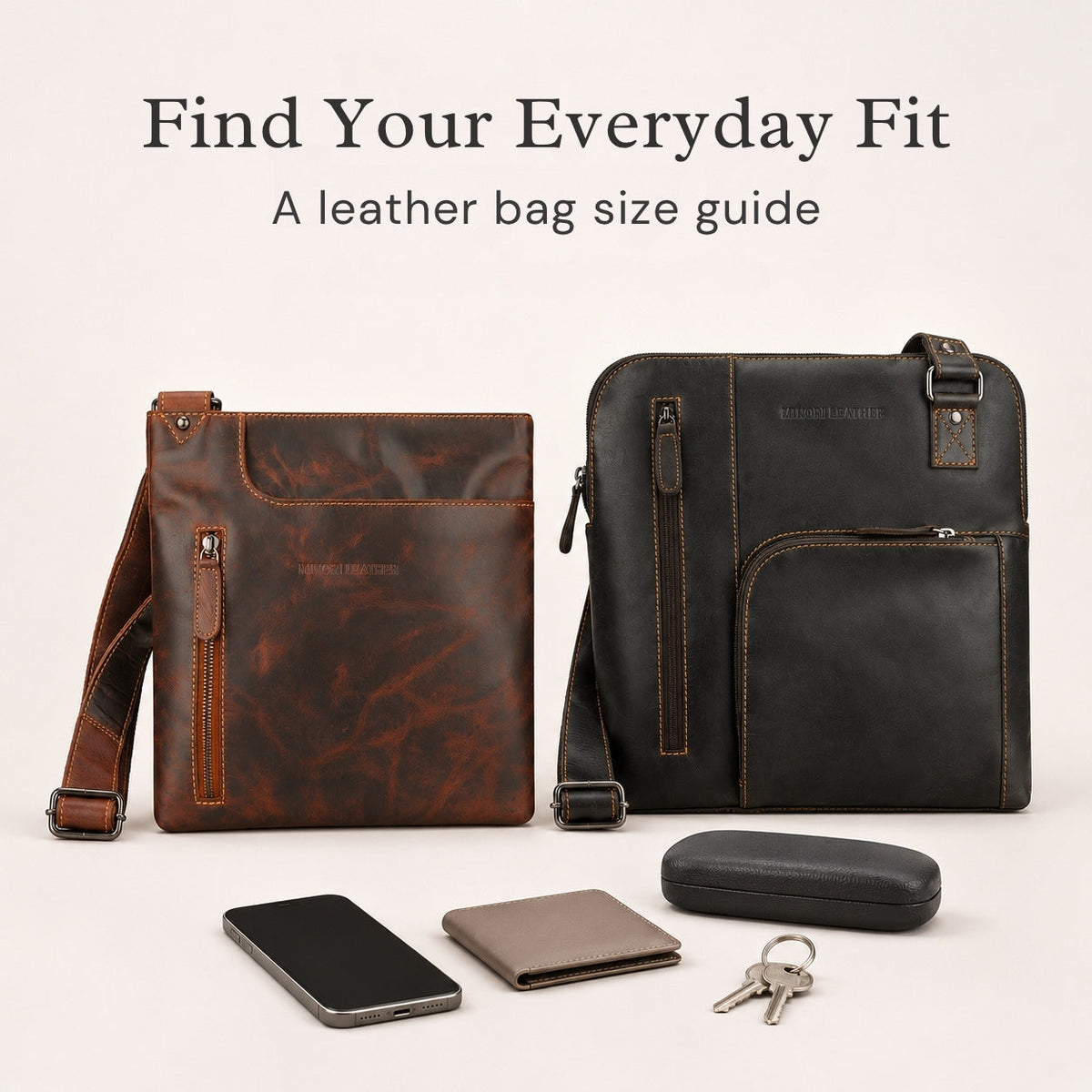
Leather Bag Size Guide: How to Choose the Right Bag Online.

A bag can look just right on your screen and feel surprisingly different when it arrives. Perhaps your wallet takes up more room than expected, the handles feel snug over a coat, or the bag sits lower on your hip than you imagined.
That is why choosing a leather bag online takes more than finding a style you love. The useful question is: will its size, shape, and carrying options work for your everyday routine?
This leather bag size guide will help you turn product measurements into something you can picture. With a measuring tape, a bag you already own, and a few minutes with your daily essentials, you can make a more informed choice before ordering.
Start with what you actually carry
Before comparing bags, empty the one you use most often. Separate the things you reach for every day from the items that have simply collected at the bottom.
Your everyday group might include a phone, wallet, keys, glasses case, and a small pouch. A workday may add a notebook, laptop, and charger. For a day out, you might want room for a water bottle or compact umbrella.
Keep items in the cases and pouches you normally use. A phone with a protective case needs more room than a bare phone, and a filled wallet occupies more space than an empty one.
Then identify your least flexible item. A rigid glasses case, notebook, or tablet often determines the minimum space you need. Measure that item first, including its thickness.
Choose for your usual day, then decide how much extra room you want. If you only occasionally carry a laptop, consider whether every outing really needs a laptop-sized bag.
Use a familiar bag as your reference
The easiest way to understand an unfamiliar measurement is to compare it with something you know.
Choose a bag you already own and ask yourself what works about it. Is it comfortably compact? Does your wallet fit but leave little space for anything else? Do you wish it were shallower, lighter, or easier to reach into?
Measure its body in three directions and write down the results. Record the handle drop or adjustable strap length separately.
A simple comparison note is useful:
| Measurement or feature | Current bag | Bag you are considering |
|---|---|---|
| Horizontal body measurement | Measure yours | Check the product listing |
| Body height | Exclude the handles | Check what the seller includes |
| Depth | Measure front to back | Check the side or base measurement |
| Handle drop or strap range | Record your comfortable setting | Compare the same type of measurement |
| Opening and interior layout | Note any tight spots | Review photos or ask for details |
This makes your decision more specific. You might discover that you need additional depth rather than extra height, or a wider opening rather than a larger bag overall.
Understand the dimensions on the product page

A handbags' dimensions describe its outside shape. The labels and measurement points can vary between sellers, so read the letters beside the numbers rather than assuming that every listing uses the same order.
Length or width: the horizontal measurement
This usually describes the distance across the front of the bag. Some brands call it length; others call it width.
Check where the measurement was taken. A tote that flares outward may be wider at the top than at its base. A rounded bag may be widest through the middle. Neither measurement alone tells you the size of the opening.
Height: the body from bottom to top
Body height generally excludes handles and straps, but check the listing if that is unclear. A tall bag may suit upright belongings, while a low, wide bag may encourage you to place them horizontally.
Consider access as well as storage. A little more height can be useful, but you should still be able to find the items you reach for frequently.
Depth: the space from front to back
Depth is easy to overlook in a front-facing product photo. It matters when you carry bulky objects or want to place several items beside one another.
Two bags can have similar front dimensions and very different side profiles. Always check a side or base photo alongside the written measurements.
Compare like with like. If one listing uses L × H × W and another uses W × H × D, first identify which number represents each direction. When measurements are unlabeled, ask the seller to clarify.
Check usable space, not just the outside measurements
The outside of a bag is not an empty box. Lining, seams, dividers, padding, and curved corners all affect the space available for your belongings.
The opening matters too. An item might fit within the widest part of the body but be difficult to pass through a shorter zipper or narrow entrance.
For anything that must fit, check three things:
- Can it pass through the opening comfortably?
- Can it sit inside the intended compartment?
- Can the bag close with the rest of your belongings alongside it?
If the answer depends on a close measurement, ask for usable interior dimensions and opening clearance. A specific question helps: “My notebook measures 8 × 5 × 0.5 inches. Can it pass through the opening and sit inside with the zipper closed?”
For a laptop, measure the device itself, including any sleeve you plan to use. The advertised screen size is a diagonal measurement, so it does not describe the laptop's full width, height, or thickness. Also check whether the bag offers the protection and dedicated compartment you want.
For more on choosing a work style, read our guide to choosing a leather bag for work.
Compare strap length and handle drop separately

A bag can hold everything you need and still feel awkward if the carrying position is wrong.
Strap length refers to the length along the strap. For an adjustable strap, check the shortest and longest settings. When comparing listings, confirm whether the measurement includes attachment hardware.
Handle or strap drop describes the distance from the top of the bag to the highest inside point of the handle or strap when held up. It is a different measurement from the full length along the strap.
For a shoulder tote, compare the handle drop with a bag you already wear comfortably. Think about whether you will carry it over a T-shirt, blazer, or winter coat.
For a crossbody, adjust your current bag to your preferred position and measure its strap. Use that as a starting point, while allowing for differences in the new bag's body height and attachment positions.
There is no single ideal setting for everyone of the same height. Your torso, clothing, and preferred carrying position matter. Model photos can help you picture the look, but your own comfortable bag is a more personal reference.
Read the photos as a set
A close-up shows leather texture and stitching beautifully. It gives much less information about scale.
Look for several views that answer different questions:
| View | What to check |
|---|---|
| Front | Overall proportions and pocket placement |
| Side or base | Depth, tapering, and structure |
| Open interior | Dividers, lining, access, and compartment layout |
| On a person | How the bag sits and how it is carried |
| Packed with recognizable items | A practical example of usable space |
Treat a packing photo as an example, rather than a guarantee that your own belongings will fit. Wallets, phones, and glasses cases come in different sizes. The strongest comparison combines photographs with measurements of the items you actually use.
If you struggle to picture the outline, mark the listed width and height on paper. You can also fold a simple paper model to include depth. This helps you visualize scale, but it cannot recreate curved corners, interior divisions, or the opening.
Choose a size for your routine
Labels such as mini, small, medium, and large are useful starting points. They are not a universal size chart.
Instead of deciding that you need a “medium bag,” describe the job you want it to do.
| Your routine | What to prioritize |
|---|---|
| Quick errands and light outings | Space for your essential items, easy access, and a comfortable strap |
| Everyday use with a few extras | Enough depth for your pouch or glasses case, plus room to close the bag comfortably |
| Work or study | Verified device or notebook fit, suitable organization, and comfortable carrying when loaded |
| Days involving a lot of walking | A manageable total weight, useful strap adjustment, and access to frequently used items |
If you are deciding between two similar bags, compare the specific difference that matters to you. Additional depth may accommodate a bulky case; additional width may help with a longer wallet. Extra exterior space is most useful when the opening and interior layout also suit your belongings.

Leave room for everyday use
Being able to squeeze everything inside is different from being able to use the bag comfortably.
You should be able to close it without forcing the fastening, remove your phone without unpacking the main compartment, and return your wallet without rearranging everything.
Think about weight as well. A larger leather bag may give you more flexibility, but check its empty weight where listed and consider what you will add. Choose the capacity you need with a little breathing room, rather than buying extra space automatically.
Your final check before ordering
Before you decide, confirm that you have:
- Compared the body dimensions with a bag you know.
- Measured your largest essential item with its case or sleeve.
- Checked the opening and any important interior compartments.
- Compared strap length or handle drop using the same measurement method.
- Reviewed side, interior, and on-person photos where available.
- Allowed space for the closure and easy access to your belongings.
- Checked the current delivery and return terms.
If one missing measurement could change your decision, ask about it before ordering. A quick check is easier than discovering that your everyday wallet does not fit the way you expected.
Frequently asked questions
How do I know whether a leather bag will be too small?
Compare it with a bag you already use, then check your largest everyday item against the opening and usable interior. Consider the whole load together, rather than testing each item separately. Leave enough room for the bag to close and for you to reach inside.
Do handbag measurements include the handles?
Body measurements generally exclude handles and straps. Handle drop and strap length are usually separate specifications. If the listing does not make this clear, ask before comparing it with another bag.
Is a deeper bag always more spacious?
Additional depth can provide useful room, but shape and internal layout also matter. A central divider or narrow opening may limit how that space can be used. Read the dimensions alongside the interior and side photos.
Should I choose a small or medium crossbody bag?
Choose according to your own essentials rather than the size label. If your current compact bag holds everything comfortably, compare new bags with its measurements. If a particular item makes it difficult to close, identify which dimension or compartment needs more room.
Can I judge bag size from a model photo?
A model photo helps you understand proportions and carrying position, but camera angle, model height, and strap adjustment affect how the bag appears. Use it alongside written dimensions and your own measurements.
Find the size that feels right for you
The right leather bag should make your day easier. Start with what you carry, use a familiar bag as your reference, and check the details that photographs alone cannot explain.
Explore the Minori Leather collection with your measurements beside you. If you need help checking a particular item or carrying option, contact us at sales@minorileather.com before ordering.
The right size starts with what you carry.



Leave a comment
This site is protected by hCaptcha and the hCaptcha Privacy Policy and Terms of Service apply.